



Introduction to the Star Spawn Species:

The leading hypothesis among xenobiologists is that humanity has fundamentally misunderstood the Star Spawn by treating them as animals. Unlike many mythological depictions, the Star Spawn are now believed to comprise of ancient related eldritch lifeforms.

“The greatest mistake is assuming they are monsters. Monsters evolve. Star Spawn predate evolution itself.” -Dr. Helena Bozeman, Notes From the Ninth Observatory

Anatomy

Grown Star Spawn possess no fixed anatomy in the terrestrial sense. Their bodies appear to exist in a semi-stable state, continually reorganizing according to local physical laws.

To human observers, they commonly exhibit:

  • Appear inanimate when viewed by a higher outside force.
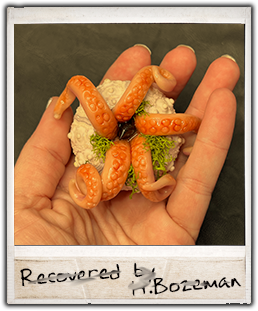
  • Have radial rather than bilateral symmetry.
  • Numerous prehensile appendages capable of fine motor skills.
  • Dense musculature with no recognizable skeletal framework with the exception of beaks in some species.
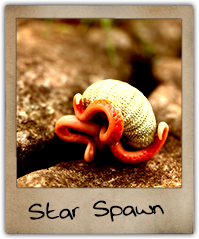
  • Young will continue to use their hatchling shells as shelter and nutrition.

Microscopic examination has reportedly revealed that individual cells constantly exchange position, making permanent injury nearly impossible.

No organs have been consistently identified. Researchers believe every portion of a Star Spawn performs multiple biological functions simultaneously. Their blood (or equivalent fluid) is described as black with shifting violet luminescence, though witnesses disagree whether the substance is liquid or merely appears so while observed.

Phylogeny

Traditional evolutionary classification fails completely. No fossil record has ever been identified. Some researchers argue they cannot leave fossils because they never truly die. Current leading theories include:

The Primordial Organism Theory
Star Spawn descend from the first self-organizing matter that emerged before stars fully ignited. According to this hypothesis, they evolved in a universe governed by different physical constants.

The Extracosmic Theory
Star Spawn are not native to this universe. Instead, they migrated here through naturally occurring fractures in spacetime billions of years ago. This theory attempts to explain why many biological processes appear impossible under known chemistry.

The Distributed Consciousness Theory
Rather than individuals, Star Spawn may represent organs of a vastly larger organism existing outside observable dimensions. Each encountered specimen may simply be a temporary projection.


Physiology and Ecology

Before star spawn become unspeakable horrors they may spawn in the most ordinary of places. No one knows what the exact conditions are but when are just right, a varying brood will emerge.  Usually less than a dozen each spawning cycle, the species of spawn varies with the broods themselves.  

For the first several weeks of their lives, they will remain near the safety of cover as they grow in size.  Depending on their sub-type, the hatchlings either hunt for their food, or wait for the food to come to them.  Some species will drag their eggshells, still rich with nutrients to a safe position and passively absorb background radiation.  When they reach adolescence they will leave their shells and egg sacks behind in each of host for the next phase of their lives.  

The information is limited as only a single area has been documented to repetitively produce broods.  The location of this area is highly guarded secret due to the concerns it posses to the general public.


In Human Culture

“The Star Spawn are not visitors from space. Space is simply one of the places through which they pass.” —Dr. Helena Bozeman, Notes From the Ninth Observatory

No verified historical record identifies the Star Spawn by name. If such beings have influenced human civilization, they have done so indirectly, leaving behind recurring symbols, traditions, and fragments of mythology rather than clear accounts. Across thousands of years of recorded history, researchers have noted a peculiar tendency for isolated cultures to produce strikingly similar stories despite having no apparent contact with one another.

Among those who study the subject, an unspoken rule has quietly developed. Every attempt to construct a complete account of the Star Spawn ultimately fails. Descriptions conflict. Names change between manuscripts. It is as though the phenomenon resists being preserved in a single, coherent narrative.

One anonymous archivist left only a single note at the conclusion of an otherwise meticulous catalog: 

“The oldest religions ask where humanity came from. The oldest stories ask who was already here.” —From Codex Anthropica Noctis

Scrap Paper

[You unwrinkled the scrap piece of paper you found.  It’s strange…the writing on the paper looks familiar…]

“I have tried everything to open the lock on the last book. There was a note attached to it that said it would only unlock in the shadow of the moon…or whatever that means.” 

How to Play

[You pick up a piece of scrap paper. These brackets indicate an in-game character action.]


“Everything has a part to play.”